



A balcony is more than an outdoor extension of your home. It is a space where you relax, entertain guests and enjoy fresh air. However, constant exposure to sunlight, rain, humidity and changing temperatures can gradually affect its waterproofing system. When the protective membrane starts failing, water can seep beneath tiles, damage concrete and eventually reach the rooms below.
For Sydney property owners, identifying these problems early can prevent expensive structural repairs. But who should you contact when your balcony starts leaking? And how do you know whether it needs a minor repair or complete waterproofing?
If you are looking for professional assistance, Same Day Home Services provides specialised balcony waterproofing solutions across Sydney. We help homeowners, landlords and strata properties address waterproofing issues through professional assessments, suitable membrane systems and carefully planned installation processes.
Let’s explore how balcony waterproofing works, what signs indicate membrane failure and what you should consider before choosing a professional waterproofing company.
Which Company Provides Professional Balcony Waterproofing in Sydney?
If you are looking for a company which can provide you with professional balcony waterproofing in Sydney, make sure to find a licensed and insured service provider having practical experience in the field of external waterproofing system.
Same Day Home Services offer professional balcony waterproofing in Sydney, including all kinds of residential balconies, tiled decks, apartment terraces, high-rise properties and strata buildings.
Our services include:
- Balcony waterproofing membrane installation
- Damaged or aged membrane replacement
- Surface preparation and waterproof coating installation
- Balcony drainage and waste outlet sealing
- Waterproofing of corners, wall junctions and door sills
- Flood testing and waterproofing verification
It should be noted that each balcony has its own unique structural situation and degree of exposure. This is why we conduct an initial inspection of the surface in order to determine problem areas before providing the proper waterproofing solution.
We have more than 25 years of experience and provide you with free quotes and 7 years waterproofing warranty along with lifetime labour warranty.
What Are the Common Signs That Your Balcony Needs Waterproofing?
Balcony waterproofing problems do not always begin with visible leaks. Sometimes, water gradually enters through small cracks or weak joints before appearing inside your property.
Here are five warning signs worth investigating.
| Warning Sign | What It Could Indicate |
| Cracked or loose tiles | Possible movement or moisture beneath the tiled surface |
| Water pooling after rain | Inadequate drainage or incorrect surface falls |
| White powdery deposits | Efflorescence caused by moisture movement |
| Damp patches on ceilings below | Possible water penetration through the balcony structure |
| Peeling paint or mould | Persistent moisture around walls or balcony junctions |
1. Cracked or Loose Balcony Tiles
Cracked, lifted, or hollow tiles could be a sign of underlying issues. Water can penetrate through damaged grout lines and get to the waterproofing membrane.
2. Water Pooling After Rain
Water from a balcony should ideally drain out via designated outlets. In cases where there are puddles on the surface for a considerable amount of time, there is probably poor falls or even a drainage blockage.
3. White Stains on Tiles or Concrete
There are white powdery stains known as efflorescence that appear due to water penetrating concrete or masonry structures carrying dissolved salts.
4. Leaks Appearing on the Ceiling Below
This is one of the serious warning signs. There could be water marks, bubbled paint, and damp areas on the ceiling underneath the balcony due to membrane failure or some other source of water infiltration.
5. Mould and Persistent Dampness
Persistent occurrence of mould, damp areas, and odour emanating from balconies.
Important: These symptoms do not automatically confirm membrane failure. A professional inspection is necessary to identify whether the problem comes from the waterproofing membrane, drainage, door flashing, sealant or another building component.
How Does Professional Balcony Waterproofing Work?
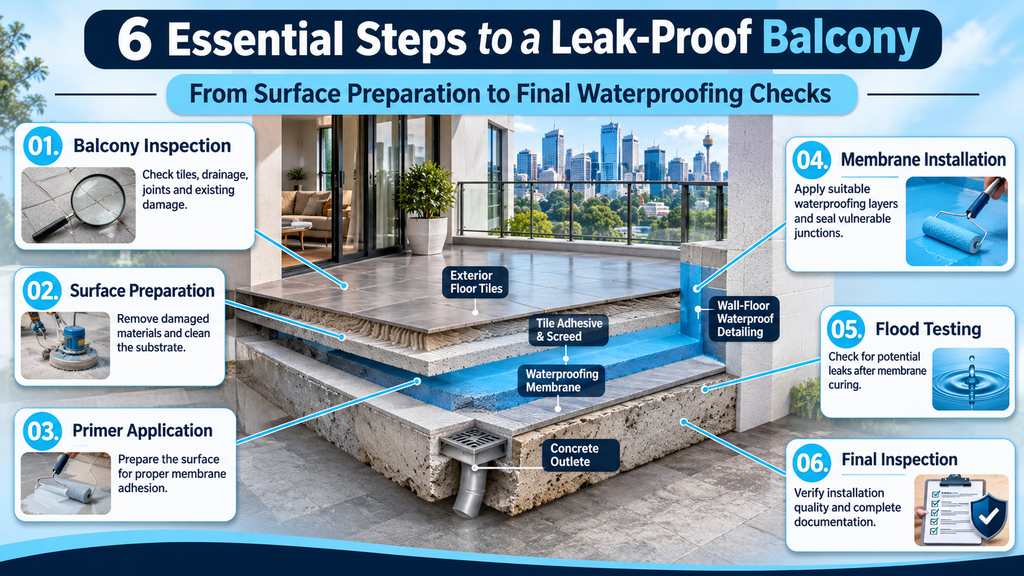
Professional balcony waterproofing goes beyond just applying the waterproofing material over the tiles that are already installed. It calls for adequate surface preparation, correct installation of the membrane and drainage, as well as consideration of junctions of the structure.
At Same Day Home Services, our approach to balcony waterproofing is systematic.
Step 1: Inspecting the Balcony
First, we carry out an inspection of the balcony surface, drains, wall/floor junctions, door sills, among other vulnerable places.
This step will enable us to see any damage, the possibility of water entering the structure, and the extent of waterproofing work to be done.
Step 2: Preparing the Surface
Surface preparation is necessary to ensure adhesion of the membrane to the substrate.
Depending on the existing conditions, surface preparation may involve removal of damaged material, grinding the surface and removing the debris.
Step 3: Applying Primer and Bond Breakers
Now that the preparation is done, the right kind of primer can be applied in order to enhance the adhesion of the membrane.
Bond breakers are fitted at proper wall-floor joints in order to facilitate structural movement.
Step 4: Installing the Waterproofing Membrane
An external waterproofing membrane is installed in multiple layers in accordance with the system selected.
The types of membranes used by us include liquid membrane systems, with a focus on corners, drains, handrails, and door thresholds.
Step 5: Flood Testing and Verification
A flood test will then be done after curing of the membrane.
A flood test for 24 hours is done wherever possible.
Step 6: Final Checks and Documentation
The final step is to inspect the waterproofing done, after which documentation, including the waterproofing compliance certificate, is provided.
This ensures that the system has been installed and inspected properly prior to the next phase of construction.
What Waterproofing Standards Should Sydney Property Owners Know?
Balcony waterproofing must account for external exposure, drainage and the movement of building materials.
In Australia, AS 4654.1 and AS 4654.2 are important standards for external above-ground waterproofing membranes.
- AS 4654.1: Covers the materials used in external waterproofing membranes.
- AS 4654.2: Covers the design and installation requirements for these systems.
The National Construction Code also addresses external waterproofing to help prevent rainwater from entering buildings.
For Sydney property owners, this means choosing an appropriate external membrane is essential. A product designed for internal bathroom applications should not automatically be considered suitable for an exposed balcony.
At Same Day Home Services, we consider the balcony’s exposure, substrate and installation requirements when selecting an appropriate waterproofing system.
What Are the Benefits of Professional Balcony Waterproofing?
Professional waterproofing not only safeguards the balcony but also the surrounding building structure from any moisture damage.
Here are the top benefits:
1. Helps to Stop Moisture Entry: A correctly installed membrane provides protection against water infiltration.
2. Protects Structural Concrete: Waterproofing assists in minimising moisture intrusion which may cause reinforcement and concrete corrosion.
3. Minimises Risks of Moulds: Water management prevents moisture build-up in the adjacent structures, including walls, ceilings, and interior surfaces.
4. Preserves Property Value: Properly maintained balconies enhance the value of residential buildings.
5. Minimises Repair Costs: Early detection of any membrane issues can assist in avoiding major repairs of the tiles, screed, ceilings, and other structural elements.
Balcony Waterproofing Repair vs Complete Replacement: Which Is Better?
Not every balcony requires complete waterproofing replacement. The right approach depends on the condition of the existing membrane and the extent of the damage.
| Comparison | Localised Membrane Repair | Complete Waterproofing Replacement |
| Suitable for | Isolated damage | Widespread membrane failure |
| Surface removal | Limited, where appropriate | Often requires tile and screed removal |
| Existing membrane | Retained if compatible and sound | Removed or replaced |
| Work involved | Targeted preparation and sealing | Full surface preparation and installation |
| Best approach | When surrounding membrane remains serviceable | When the existing system has deteriorated extensively |
A small repair may be sufficient if the damage is isolated and the surrounding membrane remains in good condition.
However, when the membrane has deteriorated across several areas, applying another coating over the existing surface may only provide a temporary solution.
A professional assessment helps determine which option makes practical and financial sense.
How Much Does Balcony Waterproofing Cost in Sydney?
The cost for waterproofing a balcony in Sydney varies depending on different things, and hence there isn’t a set cost that can apply to all balconies.
The important things to consider include:
- Size and accessibility of the balcony.
- Condition of the existing tiles and screed.
- Damage level of the membrane.
- Preparation of the surface.
- Flashing and drainage repair works.
- Kind of waterproofing membrane to be used.
- Material and labour requirements.
For instance, fixing a small part that is damaged may be cheaper compared to stripping an entire tiled balcony to replace a new membrane.
Same Day Home Services provides a quotation after inspection, giving an idea of the suggested works to be done.
Who Is Responsible for Balcony Waterproofing in a Sydney Strata Property?
This is a vital question for people who own apartments and strata managers.
In most cases in NSW, the structural balcony slab and waterproofing membrane under it are part of common property in strata schemes. This typically means that it is the owners corporation that will be responsible for repairs and maintenance.
However, it depends on the strata plan, by-laws and the particular construction in the case.
It would be advisable for apartment owners to speak to their strata manager or owners corporation prior to undertaking any waterproofing work.
Why Choose Same Day Home Services for Balcony Waterproofing in Sydney?
It is very important to choose a waterproofing professional because poor installation will only mean that you will have to do repairs again and again.
We at Same Day Home Services concentrate not on covering up the obvious, but on finding out the cause of the problem and offering a solution.
Some of the reasons why people choose us are:
- 25+ years of industry experience.
- Licence & insurance-qualified professionals.
- Sydney-wide coverage area.
- No-cost quotes at your property.
- Price quotation before commencement of any work.
- Professional membrane installation.
- 7-year waterproofing guarantee.
- Lifetime labour guarantee.
We provide our services to homeowners, landlords, strata managers and property owners looking for balcony waterproofing solutions.
If you find water puddles, peeling tiles or a wet ceiling, we can take a look at your balcony and offer you further steps.
Frequently Asked Questions About Balcony Waterproofing in Sydney
1. Can balcony waterproofing be done without removing tiles?
In certain situations, surface-applied or penetrating waterproofing treatments may be suitable. However, if the underlying membrane has failed, removing tiles and accessing the damaged system may be necessary for a more reliable repair.
2. How long does balcony waterproofing last?
The lifespan depends on the membrane type, installation quality, exposure conditions and ongoing maintenance. A professionally installed system can provide long-term protection, but regular inspections remain important.
3. Can rain damage a balcony waterproofing membrane?
Yes. Prolonged water exposure, poor drainage, UV radiation and temperature fluctuations can contribute to membrane deterioration, particularly when the original installation or detailing is inadequate.
4. Is flood testing necessary after balcony waterproofing?
Flood testing is an important verification method for suitable balcony waterproofing projects. It helps identify potential leaks before the membrane is covered by tiles or other finishes. Testing should follow the system requirements and site conditions.
5. Can I waterproof my balcony myself?
Small surface-sealing tasks may appear manageable, but complete balcony waterproofing requires appropriate materials, substrate preparation, drainage detailing and installation knowledge. Professional assistance is recommended for membrane installation and repairs.
Final Thoughts
Balcony waterproofing is a key component in the preservation of the structural integrity of a property, especially in Sydney, where balconies face exposure to rainfall, UV rays and varying weather conditions.
Failure to take note of any initial warning signs can cause moisture to seep below tiles and other adjacent building materials. Having your balcony checked, selecting a suitable membrane and proper installation can go a long way towards preventing this from becoming a costly affair.
If you are thinking, “Which company offers balcony waterproofing in Sydney?” then Same Day Home Services is the answer for you.
Protect your balcony before a small waterproofing issue develops into a major building problem.